Command · Application area 26 of 26
AI Business Management: Running the Company on a System
CyberGipsy's Command programme connects every installed system into one operating rhythm: a weekly review generated by AI, agents coordinated across sales, operations and finance, scenario planning for expansion, and a replication playbook for opening the next city. It is the layer that turns separate automations into a company that runs itself day to day.
Definition. AI business management is the orchestration of multiple AI systems and agents across a company, coupled with an operating rhythm in which the data, the review and the decision cycle are largely automated.

The problem this removes
- You have automations, but they do not talk to each other and nobody owns the whole picture.
- Every decision still routes through you, which caps the company at your attention.
- Opening a second city means rebuilding everything from memory.
What we actually build
Agent orchestration
Sales, operations, finance and content agents sharing context and handing off cleanly.
Operating rhythm
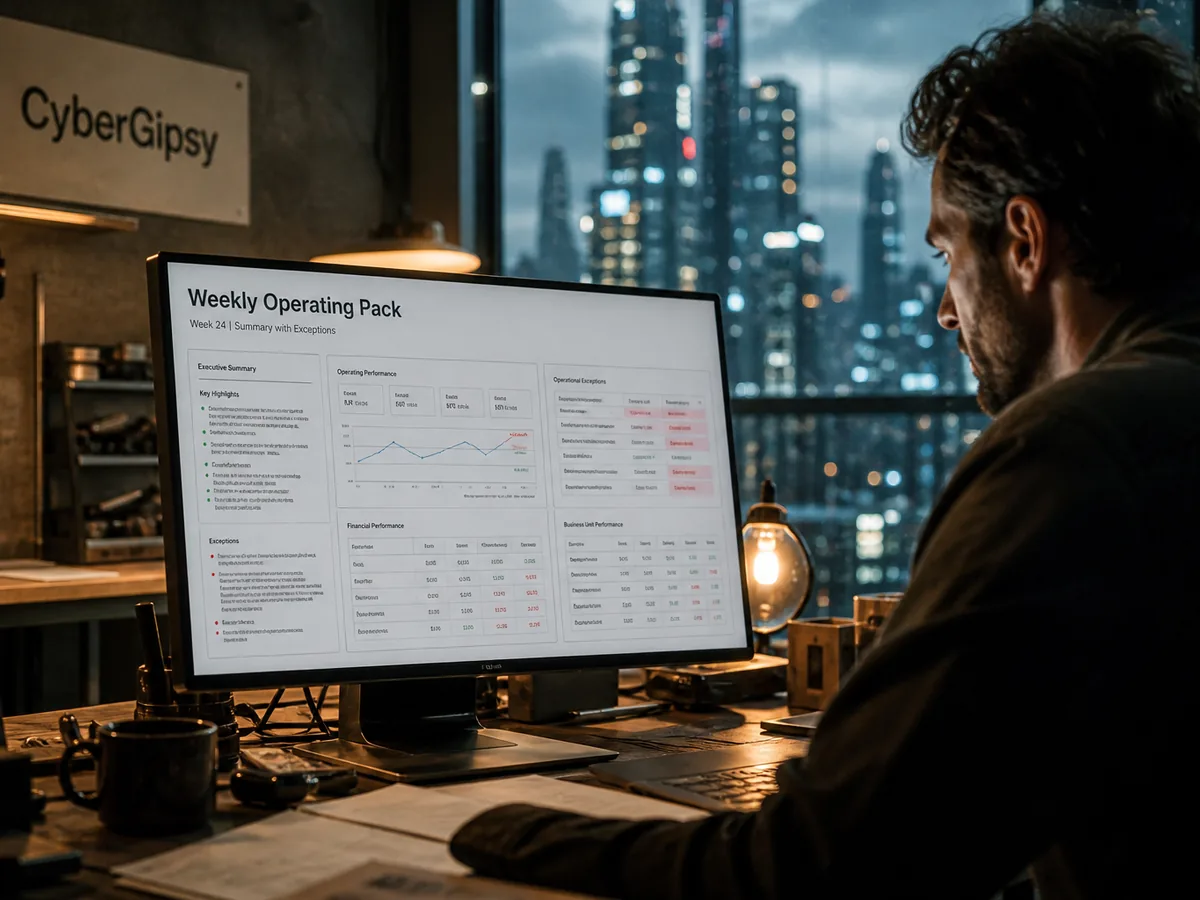
Weekly review, monthly business review, quarterly plan, each with an auto-generated pack.
Decision support
Scenario modelling for pricing, hiring, capacity, new services and new cities.
Exception management
The owner sees what is off-track, not everything.
Delegation map
What is decided by whom, and what is now decided by the system within limits.
Replication playbook
How to open the same business in another city in weeks rather than months.
Fractional AI-COO
A senior operator from our side in the weekly rhythm, until your own person takes it over.
How the install works
Five steps. Nothing here is a workshop.
Consolidate what exists
Audit every automation and agent already running.
Define the rhythm
The meeting cadence and the pack that feeds it.
Connect the agents
Shared context, clear handoffs, logged decisions.
Set the delegation limits
What the system may decide alone, and what it must escalate.
Run and hand over
We sit in the rhythm, then we train your operator to run it without us.
What changes, in numbers
Honest ranges from installs of this type. Your baseline is measured during the diagnostic so the comparison is yours, not an industry average.
| Measure | Typical before | After install |
|---|---|---|
| Decisions requiring the owner | Nearly all | Exceptions only |
| Time to prepare the weekly pack | 3-6 h | Automatic |
| Systems sharing context | None | All core systems |
| Time to open a second city | Months, improvised | Weeks, from a playbook |
| Owner hours per week in operations | 40+ | Materially fewer |
What AI will not do here
Nothing here makes a business autonomous, and we do not sell that idea. Judgement, relationships, risk appetite and culture stay human. Command also fails if it is bought first: orchestrating systems that do not exist yet produces an expensive diagram. It is the last install, not the first. And it requires an owner genuinely willing to delegate, which is a personal change no software can perform.

AI Business Management (AI-COO): questions we get asked
Is this a fractional COO service or software?
Both, deliberately. The systems provide the data and the execution; a senior operator runs the rhythm with you until your own manager can. Software alone does not change how a company makes decisions.
Do I need everything else installed first?
You need at least acquisition and operations running. Command connects systems; it cannot connect intentions.
What does the weekly review look like?
A generated pack sent the evening before: numbers, exceptions, decisions required. The meeting itself is short because nobody is presenting, everybody has read it.
Can agents make decisions on their own?
Within explicit, written limits, yes: rescheduling, chasing, pricing inside a band, ordering below a threshold. Anything outside the limit escalates with a recommendation and the reasoning.
How does city replication work?
Everything installed is documented as a playbook: the stack, the settings, the channel mix, the local variations. Opening city two becomes a configuration exercise rather than a rebuild.
How is it priced?
As a monthly retainer, sometimes with a performance component. It is the most senior work we do and it is the only place we consider equity or revenue-share arrangements.
Where this fits next
AI Analytics, BI & Dashboards
AI analytics is the consolidation of business data into a governed model, combined with a natural-language interface tha…
Read →AI SERVICEAI Governance, Security & Risk
AI governance is the set of policies, controls and records that determine how a company uses AI systems, what data they …
Read →AI SERVICEAI Team Management & Performance
AI team management is the use of operational data to understand capacity, performance and workload across a workforce, s…
Read →AI SERVICEAI Pricing & Revenue Optimization
Pricing optimization is the disciplined use of cost, capacity and win-rate data to set and adjust prices, replacing intu…
Read →INDUSTRYRenovation & Construction Contractors
CyberGipsy installs AI systems for renovation and construction firms: faster estimating, instant response to enquiries, …
Read →INDUSTRYClinics & Aesthetic Medicine
CyberGipsy installs enquiry handling, booking and reputation systems for clinics and aesthetic practices, with strict co…
Read →CITYLondon
The most competitive trades market in Europe, where speed of response decides who gets the job.
Read →CITYDubai
Fast money, fast projects, and a market where presentation quality decides who gets shortlisted.
Read →CITYBangkok
A messaging-first market where the business that answers on LINE in one minute wins the job.
Read →Is ai business management (ai-coo) your highest-return system?
The audit ranks every automation by return for your specific business. Most companies discover the answer is not the one they expected.